WalkingPad P1 review
As an Amazon Associate we earn from qualifying purchases. This does not change which products are recommended. Disclosure.
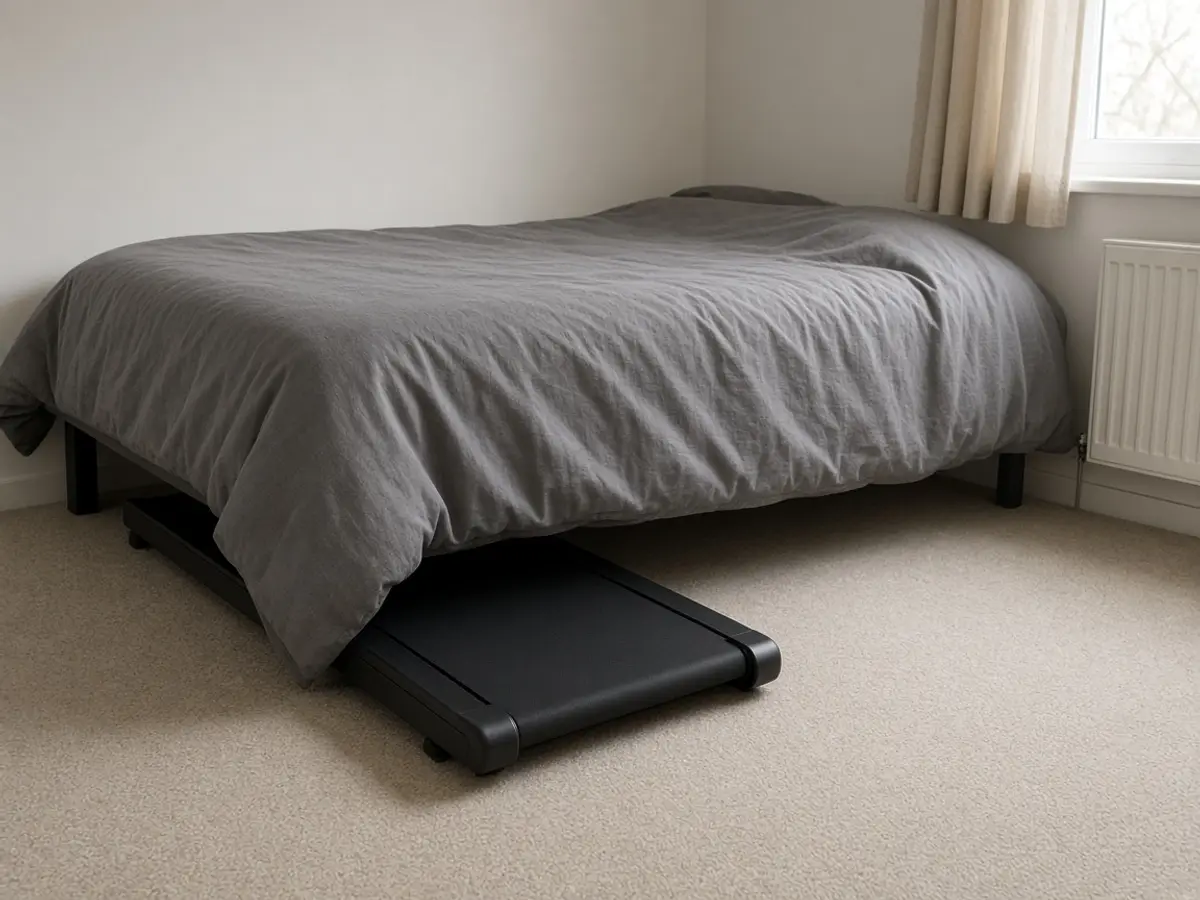
Verdict
The WalkingPad P1 is a long-running folding walking pad with an automatic mode that speeds up and slows down with your pace. It suits lighter users who want a long deck that folds away, but its 100 kg limit is the lowest in this guide and it weighs 28 kg. Most buyers will be better served by the newer WalkingPad Z1, which is lighter and rated to 110 kg.
Specifications that matter
| Speed | 0.5–6 km/h |
|---|---|
| Incline | None |
| Max user weight | 100 kg |
| Walking area | 120 × 41.5 cm running board |
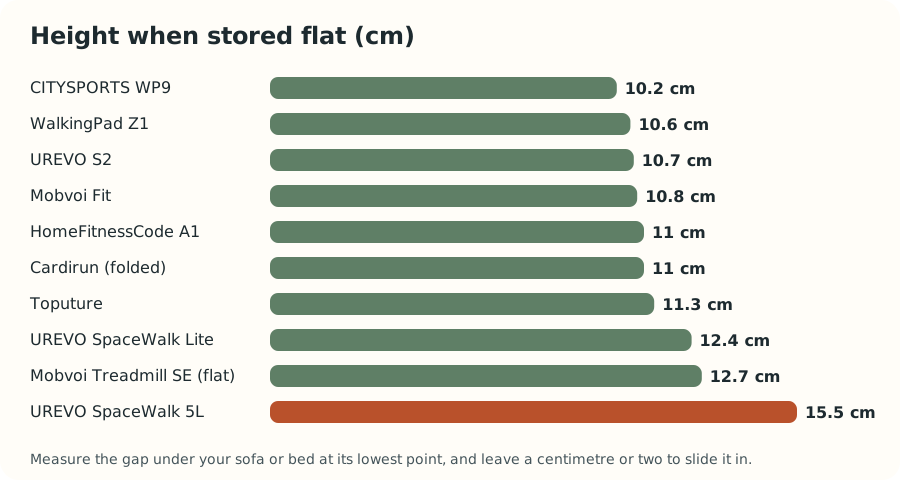
| Deck height | 12.9 cm (57 mm platform quoted) |
| Machine weight | 28 kg |
| Folding / storage | 82.2 × 54.7 × 12.9 cm (folds in half) |
| Motor (as listed) | 2 HP (as listed) |
| Handlebar | No |
| Controls / app | Remote and KS Fit app |
| Noise | Described as quiet; no dB figure given |
| Assembly | Arrives assembled |
| Warranty (as listed) | 1 year |
| Amazon UK ASIN | B09789DHP3 |
From the WalkingPad listing on Amazon UK, checked 10 November 2026. Noise figures are manufacturer claims, not measurements.
Where the listing disagrees with itself:
- The listing says both 12.9 cm overall height and a 57 mm platform. The lower figure appears to be the step-up height of the board, not the frame.
The P1 is the model that made folding walking pads familiar. It has been on sale in the UK for several years, which means spare parts and support are easier to find than for newer, short-lived models. It shares the Z1's 180° fold, but it is an older and heavier design.
Who the P1 suits
The P1 suits people who like the idea of a walking pad that responds to them. Its automatic mode, which WalkingPad calls A Mode, uses sensors to speed the belt up as you walk towards the front and slow it down as you drop back. That means you do not have to keep reaching for the remote to change pace. For some people this feels natural, especially for walking around the house rather than standing still at a desk. There is also a manual mode for setting speed with the remote or the KS Fit app.
It also suits taller, lighter walkers. The running board is listed at 120 × 41.5 cm, almost exactly the same as the Z1, so there is room for a long stride.
Like the Z1, it folds in half for storage. WalkingPad lists the folded size as 82.2 × 54.7 × 12.9 cm.
Who should skip it
Anyone near or above 100 kg should skip it. That is the lowest maximum user weight among the twelve models in this guide.
It is also heavy for its size. At 28 kg, it is 5 kg heavier than the Z1 and roughly twice the weight of the Mobvoi Fit. That matters if you plan to fold it and lift it into a cupboard every day.
If you mainly want to walk at a fixed slow pace while typing, the automatic mode may be more distraction than help. In that case the Z1 or one of the simpler UREVO pads will do the same job.
What the specifications mean
Automatic speed mode
This is the P1's distinctive feature. It is useful for free walking, but at a desk most people stand roughly still relative to the desk and want a fixed pace. You can switch to manual mode for that, so the automatic mode is a bonus rather than a drawback.
0.5–6 km/h
The 0.5 km/h minimum is slower than most pads, which start at 1 km/h. That can make the first steps easier for anyone who is cautious about getting on and off a moving belt.
12.9 cm and "57 mm platform"
The listing gives the overall height as 12.9 cm and separately describes a "low 57 mm platform". The most likely reading is that 57 mm is the height of the walking surface above the frame base or the step-up height, while 12.9 cm is the full height including the motor cover. For storage under furniture, use the 12.9 cm figure.
Motor and power
The listing gives a 2 HP motor and an input power of 735.5 W, which is simply 1 HP converted to watts. Neither figure tells you what it draws during a slow walk, which will be much lower. See our running cost guide.
Living with it
WalkingPad says the P1 arrives ready to use, with no assembly, and includes a child lock. The aluminium alloy frame is part of how WalkingPad keeps the weight down, although 28 kg is still on the heavy side. Moving it is a tilt-and-roll job on its front wheels.
The warranty is one year, and WalkingPad mentions lifetime email support. As with any walking pad, expect to lubricate and re-centre the belt from time to time.
Pros and cons
Pros
- Folds in half, with a long 120 cm running board.
- Automatic speed mode for walking without the remote.
- Very low 0.5 km/h starting speed.
- Long sales history, so support and parts are established.
Cons
- The 100 kg limit is the lowest in this guide.
- At 28 kg it is heavy to lift and fold.
- Older design than the Z1, with no clear advantage for most desk users.
- Walking only, top speed 6 km/h.
Alternatives on this site
WalkingPad Z1
The one to look at first if storage is the main problem. It folds in half to about 81 cm long and is only 10.6 cm high when flat, although the 110 kg user limit is lower than many rivals.
Lighter at 23 kg, rated to 110 kg, slightly lower at 10.6 cm and quoted as running under 45 dB.
UREVO SpaceWalk Lite
A simple, light pad with a 100 × 40 cm walking area and the only two-year warranty among the flat UREVO models here. It is a sensible choice for steady walking at a desk.
The SpaceWalk Lite does not fold, but it weighs 16 kg, is rated to 120 kg and lists a two-year warranty.
Questions
What is the difference between the WalkingPad P1 and Z1?
Both fold in half and have decks of about 120 cm. The Z1 is lighter (23 kg against 28 kg), lower (10.6 cm against 12.9 cm) and rated to a higher weight (110 kg against 100 kg). The P1 has the automatic speed mode. Our P1 vs Z1 page covers this in full.
How does the P1's automatic mode work?
Sensors detect where you are on the belt. Walking towards the front speeds it up, staying in the middle holds the speed and dropping back slows it down. You can switch it off and use the remote instead.
Is the WalkingPad P1 suitable for 110 kg?
No. It is rated to 100 kg. Choose a model with a higher rating.