How much does a walking pad cost to run?
As an Amazon Associate we earn from qualifying purchases. This does not change which products are recommended. Disclosure.
At the Ofgem cap of 26.32p per kWh (1 October to 31 December 2026, Direct Debit average), a walking pad drawing 300 W on average costs about 7.9p an hour. At 450 W, about 11.8p; at 600 W, about 15.8p. Two hours a day, five days a week at 450 W is about £1.18 a week. Your actual draw depends on the pad, your weight and your speed.
Walking pad listings quote motor ratings in horsepower or watts. Those are not what a pad uses on a typical walk. Actual draw depends on speed, user weight, belt condition and the motor.
No manufacturer here publishes average power use at walking speeds, and we have not measured it. So instead of claiming a figure, here are worked examples at three average draws.
The calculation
Cost per hour = average power in kW × price per kWh.
The Ofgem price cap from 1 October to 31 December 2026 is 26.32p per kWh for electricity, on average, for Direct Debit customers in England, Scotland and Wales. Your own rate is on your bill.
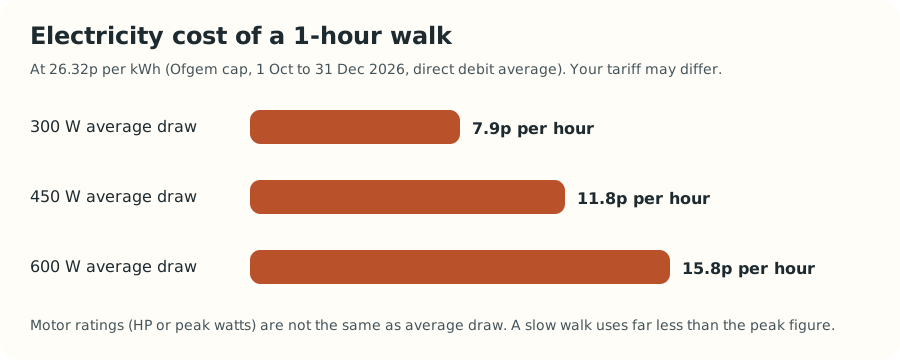
| Average draw | Per hour | 2 hours a day, 5 days | Per year (520 hours) |
|---|---|---|---|
| 300 W | 7.9p | 79p a week | £41 |
| 450 W | 11.8p | £1.18 a week | £62 |
| 600 W | 15.8p | £1.58 a week | £82 |
Worked at 26.32p per kWh, rounded.
Why the motor rating is misleading
A "2.5 HP" motor is about 1,860 W, but that is a peak figure. A pad running at 3 km/h with an average-weight user draws a fraction of its peak. The CITYSPORTS WP9 quotes a 1,400 W motor and the Mobvoi SE an 800 W input; neither tells you what it uses during a walk.
The only reliable way to know is to measure with a plug-in energy monitor.
What increases running cost
- Faster speeds.
- A heavier user.
- An incline.
- A dry or over-tight belt, which adds friction. See maintenance.
Standby
Switch the pad off at the wall when not in use. Most draw a little in standby.
How to work out your own cost
You can estimate your own running cost in three steps.
- Find your unit rate. It is on your bill or in your supplier's app, in pence per kWh. If you are on a fixed tariff, use that rate rather than the cap.
- Measure the pad's average draw. A plug-in energy monitor shows watts in real time and kWh over a session. Walk at your normal speed for 20–30 minutes and read the total kWh.
- Multiply. kWh used × pence per kWh = cost of that session.
For example, if a 30-minute walk uses 0.15 kWh at 26.32p per kWh, that session costs about 3.9p.
Regional and tariff differences
The 26.32p figure is a Great Britain average for Direct Debit customers on a default tariff. Actual capped rates vary by region: in the Ofgem figures for this period, regional rates run from about 25.4p to about 27.9p per kWh. Prepayment and standard credit rates differ, and Northern Ireland is not covered by the Ofgem cap. Fixed tariffs have their own rates.
Ofgem also notes that VAT has been removed from domestic electricity bills from 1 October 2026 to 31 March 2027, so rates after March 2027 may change.
Running cost compared with the price of the pad
For most people, electricity is a small part of the cost of owning a walking pad. Even at the highest example above, a year of two hours a day on weekdays is about £82 at current rates. The pad itself, replacement belts and lubricant are likely to cost more over its life.
Questions
Do walking pads use a lot of electricity?
At walking speeds they generally use less than their motor rating suggests. A typical hour costs pence, not pounds, at current UK prices.
Is a walking pad cheaper to run than a treadmill?
Generally, at walking speeds, yes, because the load is lower. Running on either uses more.
How can I measure my walking pad's power use?
Use a plug-in energy monitor between the socket and the pad.