How to choose a walking pad
As an Amazon Associate we earn from qualifying purchases. This does not change which products are recommended. Disclosure.
Start with the three numbers that decide whether a pad physically suits you and your home: maximum user weight (leave at least 10 kg spare), belt length (longer for tall walkers; about 100 cm is typical) and deck height (lower is easier to store and to use at a standing desk). Then decide on speed, incline, folding and warranty.
Walking pad listings are crowded with features: apps, speakers, LED screens, programmes. Most of that is secondary. These seven specifications, roughly in order of importance, decide whether a pad will suit you.
1. Maximum user weight
Treat it as a ceiling, not a target. Leave at least 10 kg between your weight and the pad's maximum. In this guide, ratings run from 100 kg to 145 kg.
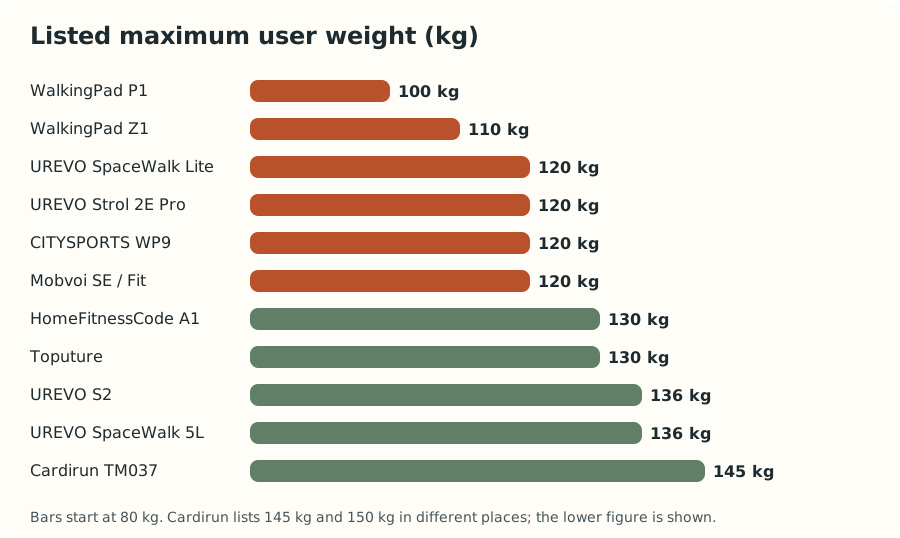
More detail: walking pad weight limits.
2. Belt length and width
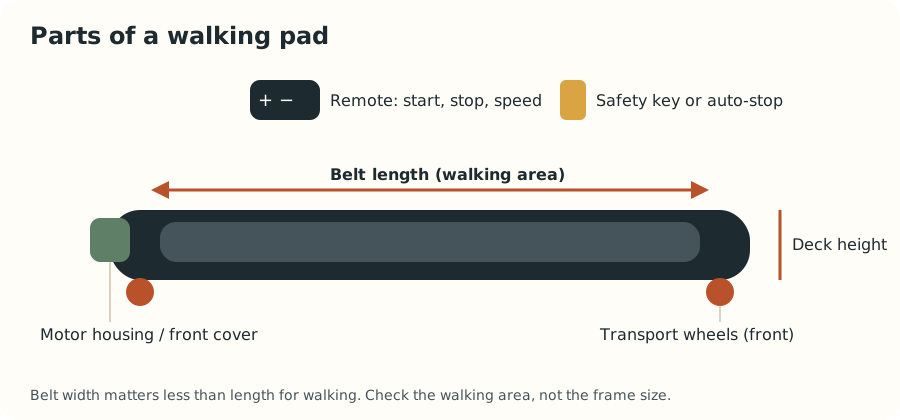
The belt is the moving surface. A longer belt gives you more room before you drift off the back. Belt lengths on the pads here run from 90 cm to 121 cm, with 100 cm the most common.
There is no official height-to-belt chart, but one manufacturer gives a useful reference: Cardirun recommends its 92 cm belt for users up to 170 cm. If you are taller than about 180 cm, look for 110 cm or more.
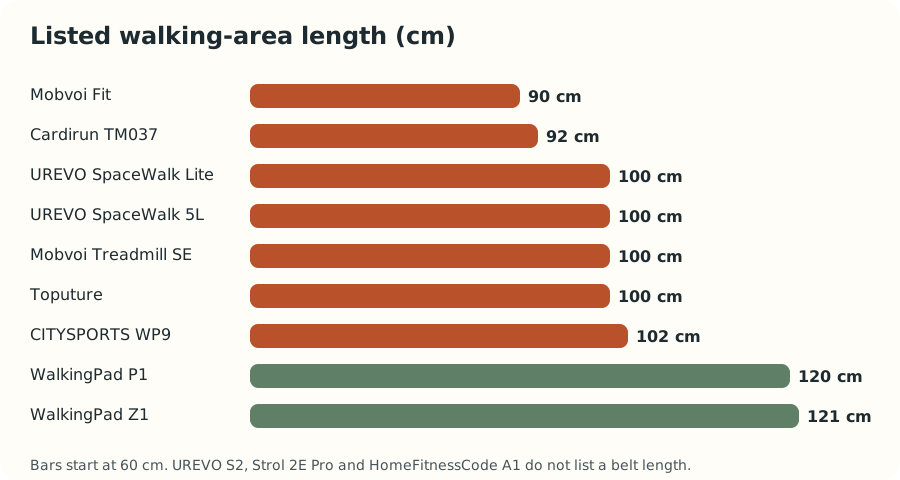
Some listings do not state the belt size at all. If you are tall, ask the seller before buying.
3. Deck height
A walking pad sits 10–16 cm off the floor. That height decides:
- whether it slides under your bed or sofa;
- how much higher your standing desk has to go;
- how big a step it is to get on.
4. Speed range
Most walking pads run at 1–6 km/h, which covers all walking speeds. At a desk, the minimum speed matters more than the maximum: many people type comfortably at 1–3 km/h. A 2-in-1 with a fold-up handle runs at 10–12 km/h for jogging.
5. Incline
An incline makes walking harder without going faster. Motorised inclines change during a walk; manual ones are set before you start. See walking pads with incline.
6. Folding or flat
Folding pads (like the WalkingPad Z1) take up half the floor space when stored, but weigh more. Flat pads are lighter and slide under furniture.
7. Warranty
Most pads here come with one year. Some offer two. Where a listing contradicts itself, confirm with the seller before buying.
Things that matter less than they seem
- Peak horsepower. Brands measure it differently. A continuous rating, where given, is more useful.
- Calorie claims. Figures like "190% more calories" are marketing.
- Noise claims. Useful as a rough guide, but not tested consistently.
- Apps. Nice to have, but every pad here works with its remote alone.
A quick checklist
- Your weight + 10 kg ≤ the pad's maximum.
- Belt length suits your height.
- Deck height fits your storage space and desk range.
- The minimum speed is low enough for desk work.
- You know where it will be stored and how you will move it.
- Warranty is clear.
Or answer six questions in the walking pad finder.
Matching the pad to the job
Most people buy a walking pad for one main reason. Here is how the specifications above line up with the common jobs:
- Walking at a standing desk. Prioritise a low deck, a 1 km/h minimum speed and a remote. See the standing desk guide.
- Small flat or room. Prioritise folding, deck height and machine weight. See small spaces.
- Upstairs or shared walls. Prioritise cushioning and a walking-only pad, and budget for a mat. See quiet pads.
- Heavier user. Prioritise maximum user weight, with a margin. See heavier people.
- Harder walks. Prioritise an incline. See incline pads.
- Walking and some jogging. Prioritise a handle and a 10–12 km/h top speed. See handlebar pads.
- Carrying it daily. Prioritise machine weight. See lightweight pads.
Reading an Amazon UK listing
Walking pad listings often repeat the same figure in several places, and sometimes those figures disagree. When reading one:
- Read the title, the bullet points and the technical details table.
- Note any figure that appears twice with different values.
- Look for what is missing, especially the belt size and the machine weight.
- Check the warranty length, and whether it is given consistently.
- Use the more cautious figure, and ask the seller if it matters.
Each review on this site lists the conflicts we found on that listing, checked 10 November 2026.
Questions
What size walking pad do I need?
For most adults, a belt around 100 × 40 cm. Taller walkers should look for 110–121 cm.
What is a good speed range?
1–6 km/h covers walking. If you want to jog, look for 10–12 km/h with a handle.
Are cheaper walking pads worse?
Not necessarily. Compare the specifications above rather than the price or the brand name.