Walking pad vs treadmill
As an Amazon Associate we earn from qualifying purchases. This does not change which products are recommended. Disclosure.
A walking pad is a low, handle-free deck for walking at up to about 6 km/h. It suits desk walking and small homes because it slides under furniture. A treadmill has a console, handrails, a longer belt and usually a stronger motor, so it suits running. A 2-in-1 pad with fold-up rails sits between them, adequate for occasional jogging but not for regular running.
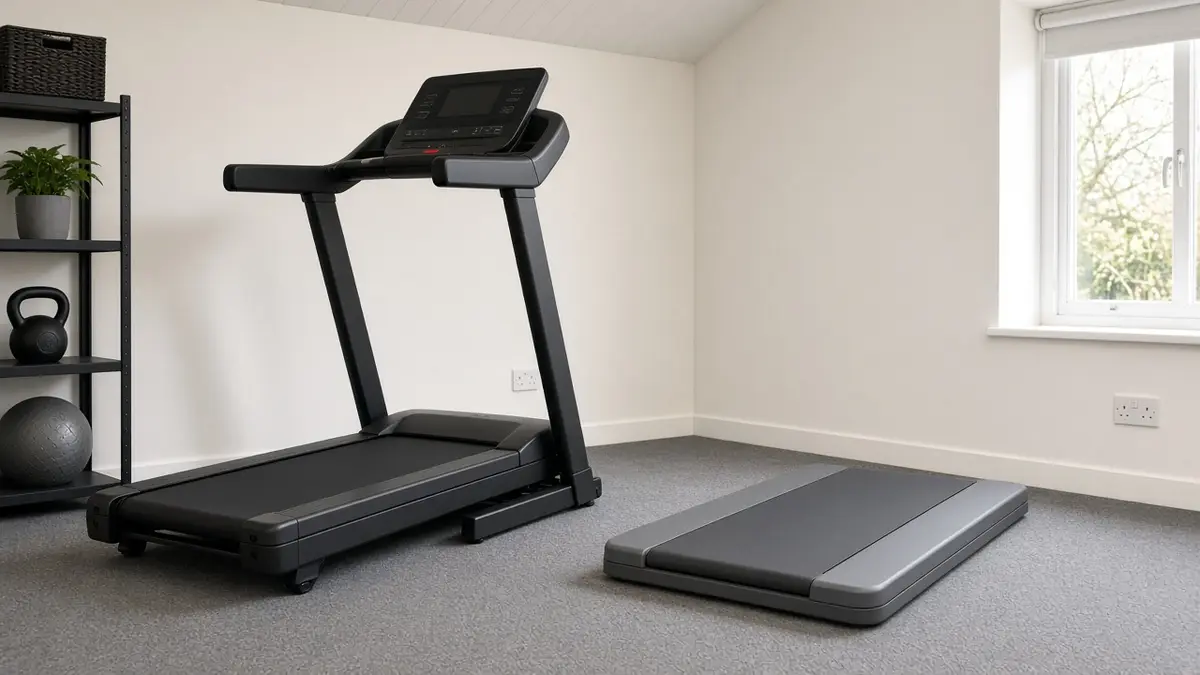
The names overlap, and some listings call walking pads "treadmills", but the two machines are built for different jobs.
The key differences
| Walking pad | Folding treadmill | |
|---|---|---|
| Height | About 10–16 cm deck, no frame | Console and rails around 120–140 cm |
| Top speed | Usually 6 km/h; 2-in-1 models 10–12 km/h | Typically 12–18 km/h or more |
| Belt | Usually 90–121 cm long | Typically longer, for a running stride |
| Handle | None, or a fold-up rail on 2-in-1s | Full handrails and console |
| Storage | Under a bed or sofa, or folded | Folds upright, still bulky |
| Use at a desk | Designed for it | Console gets in the way |
| Incline | None, manual, or a modest motorised 9% | Often motorised |
Treadmill figures are typical ranges for home folding models, not a specific machine.
Choose a walking pad if
- You want to walk while working at a standing desk.
- You need to store it out of sight.
- Your speed will mostly be 1–6 km/h.
- You live in a flat where a heavy machine and running would be a problem.
The best walking pads guide compares twelve models.
Choose a treadmill if
- You want to run regularly or train for an event.
- You want a long, wide belt and a strong motor.
- You have a room where it can stay set up.
Consider a 2-in-1 if
You mostly walk but someone wants to jog occasionally. The Mobvoi Home Treadmill SE runs at up to 12 km/h with its rails up and has a 100 × 40 cm belt. The UREVO Strol 2E Pro runs at up to 10 km/h and adds a 12% incline.
| Mobvoi Home Treadmill SE | UREVO Strol 2E Pro | |
|---|---|---|
| Speed range | 1–6 km/h walking, 1–12 km/h with rails up | 1–6 km/h walking, 1–10 km/h with handle up |
| Incline | None | 12%, manual |
| Max user weight | 120 kg | 120 kg |
| Walking area | 100 × 40 cm (39.4 × 15.8 in) | Not stated on the listing |
| Deck height | 12.7 cm folded flat | 10.6 cm folded flat |
| Machine weight | 17.6 kg | 19.7 kg |
| Folded / stored size | 101.6 × 40.6 × 12.7 cm (listed) | 114 × 55.6 × 10.6 cm (handle folds down) |
| Motor (as listed) | 2.5 HP peak, 800 W input (as listed) | 2.25 HP (as listed) |
| Handlebar | Yes, fold-up handrails | Yes, folding |
| App / remote | Remote, console buttons and TicSports app | UREVO app, syncs with Apple Health and Google Fit |
| Warranty (as listed) | 1 year | 1 year |
| See on Amazon | See on Amazon |
Noise and floors
Walking is much quieter than running for people below you, because impact noise rises steeply with speed. In an upstairs flat, a walking pad used at walking speeds is far easier on the neighbours than any treadmill used for running. See the quiet pads guide.
Running cost
Both use mains electricity. Actual use depends on speed, user weight and the motor, but walking at low speed generally uses less than running. The running cost guide has worked examples at the current UK price cap.
Cost of ownership
Both need a mat, occasional lubrication and electricity. Treadmills generally have bigger motors and draw more power at running speed, but at walking speed both use relatively little. See running costs.
Treadmills are usually heavier and harder to move once set up. A walking pad of 13–28 kg can be moved by most adults, especially with wheels. A folding treadmill typically folds upright on its own base but stays in the same room.
Safety differences
A treadmill's handrails and console give you something to hold, and its safety key is usually on the console within reach. A walking pad without a handle relies on the safety clip and on you stepping off safely. If balance is a concern, look at a 2-in-1 pad with a handle, or a treadmill. See handlebar pads.
A quick decision guide
- Will you run more than occasionally? Choose a treadmill.
- Will you walk at a desk? Choose a walking pad.
- Do you need to store it out of sight? Choose a walking pad.
- Both walking and occasional jogging, little space? Choose a 2-in-1 walking pad with a handle.
Questions
Is a walking pad as good as a treadmill?
For walking, often yes, and it is easier to store. For running, no.
Can you run on a walking pad?
Not on most. They stop at 6 km/h. A 2-in-1 model with a handle can jog at 10–12 km/h. See can you run on a walking pad.
Do walking pads last as long as treadmills?
It depends on the model, use and maintenance, and there is no reliable comparison data. Staying well within the weight limit and maintaining the belt both help.