Walking pad weight limits explained
As an Amazon Associate we earn from qualifying purchases. This does not change which products are recommended. Disclosure.
A walking pad's maximum user weight is the heaviest person it is designed to carry. Leave a margin of at least 10 kg, because each step briefly loads the deck with more than your standing weight, and a motor near its limit works harder. In this guide, limits range from 100 kg (WalkingPad P1) to 145 kg (Cardirun).
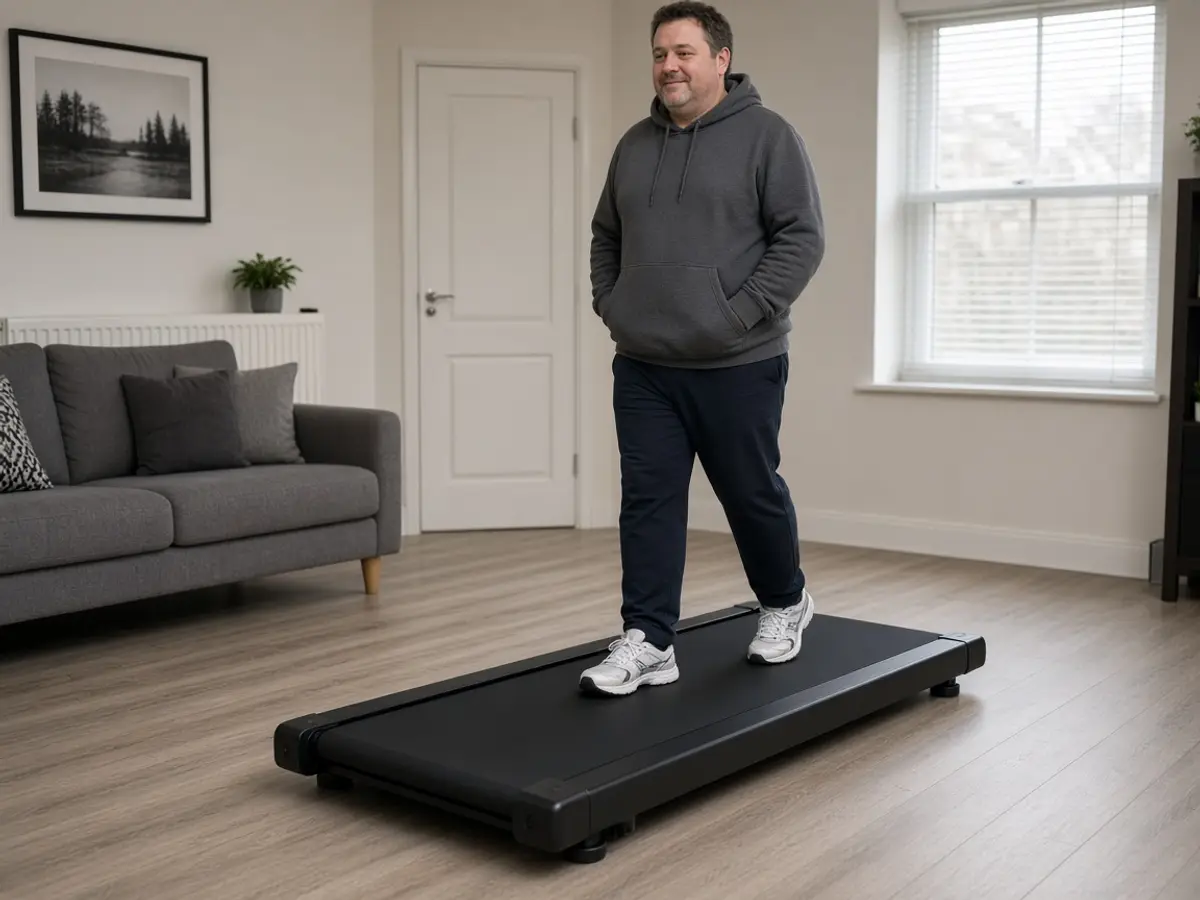
Every walking pad lists a maximum user weight. It is the most important single number for heavier users, and one of the easiest to overlook.
The range
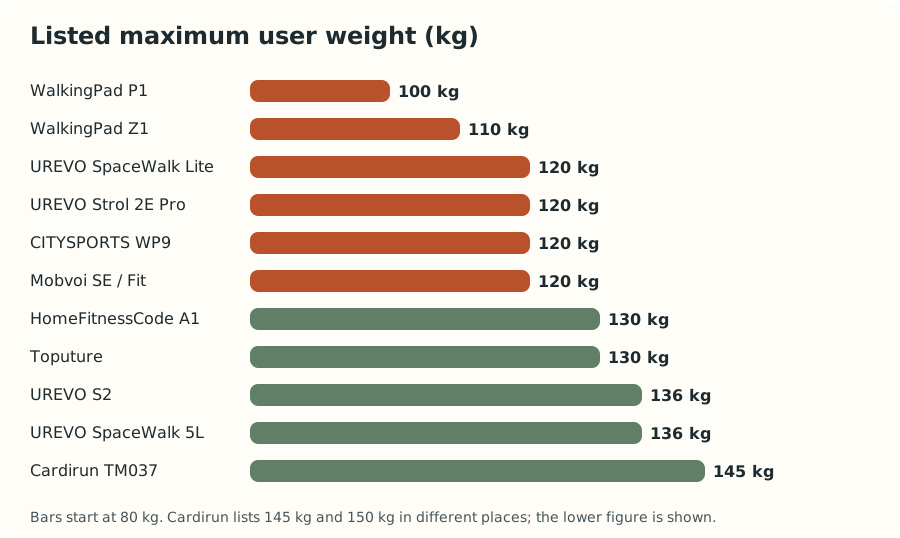
| Model | Maximum user |
|---|---|
| WalkingPad P1 | 100 kg |
| WalkingPad Z1 | 110 kg |
| UREVO SpaceWalk Lite, Strol 2E Pro, CITYSPORTS WP9, Mobvoi SE, Mobvoi Fit | 120 kg |
| HomeFitnessCode A1, Toputure | 130 kg |
| UREVO S2, SpaceWalk 5L | 136 kg |
| Cardirun 6-in-1 | 145 kg (150 kg in one part of the listing) |
Why leave a margin
- Dynamic load. When you walk, each step briefly puts more force on the deck than your standing weight.
- Motor load. A heavier user makes the motor work harder to keep the belt moving at a set speed.
- Wear. Belt, deck and rollers wear faster near the limit.
- Warranty. Using a pad above its limit is likely to affect cover.
A margin of 10–15 kg is a sensible rule of thumb.
When the listing gives two figures
The Cardirun listing says 145 kg in the bullet points and 150 kg in the technical table. When a listing contradicts itself, use the lower figure, and ask the seller if it matters to you.
What else matters for heavier users
- Belt width: wider is more comfortable.
- Cushioning: more shock absorbers spread the load.
- A handle: helpful for balance.
See walking pads for heavier people.
How to check a listing's weight limit
The maximum user weight is usually in three places on an Amazon UK listing: the title, the bullet points and the technical details table. It is worth reading all three, because they do not always agree.
- Look for the unit. Some listings give pounds (300 lb is about 136 kg; 265 lb is about 120 kg). Convert before comparing.
- Look for a second figure. If the table and the bullet points disagree, plan around the lower one.
- Check the manual if it is available. Some brands publish a PDF manual, which may be more careful than the listing.
- Ask the seller. Amazon lets you send a question to the seller from the listing.
Weight limit and the other figures
A higher weight limit often comes with other changes. On the pads in this guide:
- The two models rated to 136 kg are UREVO pads, one flat and light (S2, 16.6 kg) and one with a motorised incline (SpaceWalk 5L, 23 kg).
- The highest-rated model, the Cardirun at 145 kg, has a short 92 cm belt and is recommended for users up to 170 cm tall. A high weight rating does not mean the pad suits a tall user.
- The lowest-rated model, the WalkingPad P1 at 100 kg, has one of the longest decks.
So weight limit, belt length and height need to be considered together. The finder does this automatically: it removes any pad whose limit is less than 5 kg above the weight you enter, and removes the Cardirun for users over 170 cm.
Shared pads
If more than one person will use the pad, choose for the heaviest user, and the tallest. It is easy to buy for the person doing the research and forget everyone else in the household.
Questions
What is the maximum weight for a walking pad?
Of the models here, up to 145 kg. Some walking pads and treadmills go higher.
What happens if I am over the weight limit?
The pad may struggle, wear faster, trip overload protection or not be covered by warranty.
Does a higher weight limit mean a better pad?
Not necessarily, but it suggests a stronger frame and motor.